VidaMarkets (vidamarkets.com) is a forex and CFD broker featured in this comparison alongside four established competitors: XM, Pepperstone, Plus500 and IG. Disclosure: VidaMarkets is the featured/affiliated brand of this site, and it is included for context next to the other providers. This guide is written for readers who want to open a CFD account with a small initial deposit and need a structured way to compare regulation, leverage, platforms and costs. Brokers are assessed on the editorial criteria listed below, and where a competitor is stronger on a criterion, we say so. A low minimum deposit limits the cash you commit at the start, but it does not reduce the risk of the product. CFDs are complex, high-risk leveraged products, and a high percentage of retail accounts lose money.
Quick Comparison Table
The table below puts the featured brand first, followed by four competitors. An em dash (—) means the figure is not confirmed for this comparison or varies too much by entity to state as a single number. Minimum deposits, spreads and leverage differ by legal entity, account type and payment method, so confirm every figure on the broker's official site.
| Broker | Min Deposit | EUR/USD Spread | Max Leverage | Regulation | Platforms |
|---|---|---|---|---|---|
| VidaMarkets (featured) | — | — | — | — (verify entity and licence on the regulator's register) | — |
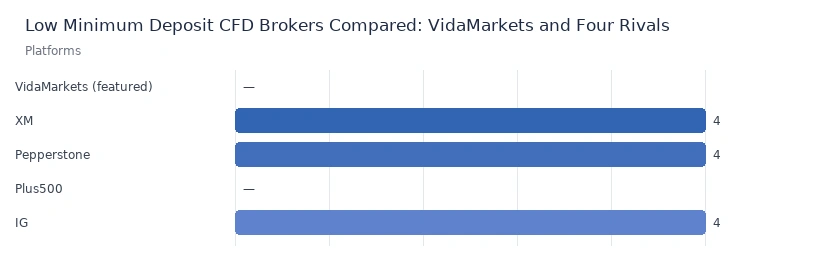
| XM | From $5 on some entities (varies by entity) | — | 30:1 for retail clients under EU and Australian rules; other entities — | CySEC, ASIC; also an offshore entity | MT4, MT5 |
| Pepperstone | — | — | 30:1 for retail clients under UK, EU and Australian rules; other entities — | FCA, ASIC, CySEC among others | MT4, MT5, cTrader, TradingView |
| Plus500 | — | — | 30:1 for retail clients under UK, EU and Australian rules; other entities — | FCA, CySEC, ASIC among others | Proprietary web and mobile platform |
| IG | — | — | 30:1 for retail clients under UK and Australian rules; other entities — | FCA, ASIC among others | Proprietary web platform, MT4, ProRealTime |
Retail CFDs are not available to US retail clients. Where a broker offers higher leverage, it is usually through a different entity, often outside the strictest regimes, or to clients classed as professional. Higher leverage also means higher potential losses.
How We Compared These CFD Brokers
The ranking criteria are editorial and are applied the same way to every broker. VidaMarkets is the site's featured and affiliated brand, so it is listed first for context, and that position is not a claim that it is the strongest option. Where public information could not be confirmed, we show an em dash rather than estimate. Competitors were chosen because they are widely known CFD brokers relevant to readers seeking small starting deposits.
- Minimum deposit: the lowest stated amount to open and fund a live account, and whether it varies by entity.
- Regulation: which regulators supervise the entity serving retail clients, and whether any entity is offshore.
- Trading costs: typical or starting EUR/USD spread, plus commissions where relevant.
- Leverage and protections: regional leverage caps and negative-balance protection.
- Platforms and account types: the trading software offered and the range of account options.
Broker Review Details
Each review below uses the same structure: a short overview, a key-facts table, three advantages, two limitations and a suggested audience. The reviews describe features and do not recommend any product. Facts reflect publicly available information and can change, so check official documents before depositing.
1. VidaMarkets — featured brand with details to verify
VidaMarkets is the featured and affiliated brand of this site and presents itself as a forex and CFD broker through its English-language website at vidamarkets.com. For a reader focused on a low starting deposit, the key task is to confirm the minimum funding amount for the account type and region, the regulated entity that would serve you, and the leverage and protections that apply to your classification. This comparison does not confirm those values, so they appear as dashes below.
| Founded | Regulation | Min Deposit | Spread | Leverage | Platforms |
|---|---|---|---|---|---|
| — | — | — | — | — | — |
Pros
- The official website is available in English, so product and legal information can be read before registering.
- It is positioned as a CFD-focused provider, which keeps the offer relevant to readers who want CFD access rather than a broad investment platform.
- Readers can request the entity name, licence number and terms from the broker and check them against a regulator's public register.
Cons
- Several comparison data points (regulation by entity, minimum deposit, spreads and platforms) are not confirmed in this article, so you must verify them yourself.
- As the featured and affiliated brand, VidaMarkets is presented here with a commercial relationship, and it has a shorter documented public track record in this comparison than long-established competitors such as IG.
Best for: readers who want to evaluate a featured brand and are willing to check its entity, licence and account terms against official sources before funding an account.
2. XM — widely marketed low entry deposits
XM, founded in 2009, is a CFD and forex broker known for low stated starting deposits on some of its entities and for offering both MetaTrader platforms. On the criterion of minimum deposit, it is objectively stronger than VidaMarkets in this comparison, because its figure can be stated while VidaMarkets' cannot. The entity matters: regulated entities and offshore entities operate under different rules, and an offshore licence should not be treated as equivalent to Tier-1 oversight.
| Founded | Regulation | Min Deposit | Spread | Leverage | Platforms |
|---|---|---|---|---|---|
| 2009 | CySEC, ASIC; also an offshore entity | From $5 on some entities (varies by entity) | — | 30:1 retail under EU and Australian rules; other entities — | MT4, MT5 |
Pros
- A very low stated entry deposit on some entities suits small initial funding.
- Both MT4 and MT5 are offered, which suits users already familiar with MetaTrader.
- Multiple regulated entities mean clients in different regions are served by different licensed firms.
Cons
- Terms vary by entity, so the headline deposit and leverage may not apply to your account.
- A group structure that includes an offshore entity requires extra care when checking which company holds your account.
Best for: readers prioritising a small initial deposit and MetaTrader access who will confirm which legal entity applies to them.
3. Pepperstone — platform choice and multiple regulators
Pepperstone, founded in 2010, is an online CFD and forex broker with a platform line-up that includes MT4, MT5, cTrader and TradingView integration. It is regulated by several authorities, including the FCA, ASIC and CySEC. We do not confirm a single minimum deposit figure here, since it depends on the entity and funding method, so check the account-opening page for your region.
| Founded | Regulation | Min Deposit | Spread | Leverage | Platforms |
|---|---|---|---|---|---|
| 2010 | FCA, ASIC, CySEC among others | — | — | 30:1 retail under UK, EU and Australian rules; other entities — | MT4, MT5, cTrader, TradingView |
Pros
- Broad platform choice covers several trading styles and software preferences.
- Oversight by several well-known regulators gives clients in those regions a regulated route.
- Account types and pricing structures are documented publicly, which helps cost comparison.
Cons
- A minimum deposit is not confirmed in this comparison, so it may not be the lowest-entry option.
- Some account types use commissions in addition to spreads, which complicates a like-for-like cost comparison.
Best for: readers who want platform variety and multi-regulator oversight and who will confirm the funding requirement for their region.
4. Plus500 — proprietary platform, simple structure
Plus500, founded in 2008, offers CFDs through its own proprietary web and mobile platform instead of MetaTrader. It is regulated in several jurisdictions, including the UK, Cyprus and Australia. The single-platform model keeps the experience consistent but limits choice. We do not confirm a universal minimum deposit, because requirements differ by region and payment method.
| Founded | Regulation | Min Deposit | Spread | Leverage | Platforms |
|---|---|---|---|---|---|
| 2008 | FCA, CySEC, ASIC among others | — | — | 30:1 retail under UK, EU and Australian rules; other entities — | Proprietary web and mobile platform |
Pros
- A single proprietary platform gives a consistent web and mobile experience.
- Regulation in several well-known jurisdictions applies to clients in those regions.
- The interface is designed for straightforward CFD access, which can suit users who prefer less configuration.
Cons
- There is no MetaTrader or cTrader option, which limits users who need those tools or automated strategies.
- The minimum deposit and typical spread are not confirmed here, so cost comparison requires checking its pricing documents.
Best for: readers who prefer a single, self-contained platform and will review its costs and terms before funding.
5. IG — long track record and broad market access
IG, whose origins date to 1974, is one of the longest-established names in leveraged trading. It is regulated by authorities including the FCA and ASIC, and it offers a proprietary web platform alongside MT4 and ProRealTime. On longevity and regulatory standing, it is objectively stronger than VidaMarkets in this comparison. We do not confirm a minimum deposit or spread figure here.
| Founded | Regulation | Min Deposit | Spread | Leverage | Platforms |
|---|---|---|---|---|---|
| 1974 | FCA, ASIC among others | — | — | 30:1 retail under UK and Australian rules; other entities — | Proprietary web platform, MT4, ProRealTime |
Pros
- A long operating history provides a deeper public record than newer firms.
- Regulation by recognised authorities applies to clients served by those entities.
- Several platform options cover different preferences, including charting-focused software.
Cons
- A minimum deposit is not confirmed in this comparison, and it may not be the cheapest route to opening an account.
- Costs depend on market and account type, so headline spreads may not match what you pay on every instrument.
Best for: readers who value an established provider and regulatory standing and will confirm costs and funding requirements.
How to Choose a CFD Broker
Start with regulation, not the deposit amount. Identify the exact legal entity that would hold your account, find its licence number in the regulator's public register, and confirm that your country is served by that entity. Treat offshore licences with caution, and remember that regulation does not remove market risk.
Next, understand leverage. Retail clients in the UK, EU and Australia face leverage caps, and negative-balance protection may apply. Leveraged trading carries a high level of risk, and losses can exceed your initial deposit where negative-balance protection does not apply. A small deposit combined with high leverage can lose its value quickly.
Then compare total costs: spreads, commissions, overnight financing, currency conversion, inactivity fees and withdrawal charges. A low minimum deposit says nothing about these ongoing costs.
Check platforms and tools against your needs, and test a demo account if one is offered. Read the risk warning, which many brokers must show with the percentage of retail accounts that lose money. Review customer support access and the withdrawal process. Finally, decide how much you can afford to lose, and do not fund an account with money you need. Past performance does not guarantee future results.
FAQ
Which are the best CFD brokers for a low minimum deposit?
There is no single answer. This is a featured brand comparison, and VidaMarkets is the site's affiliated brand. We compared regulation, minimum deposit, costs, leverage protections and platforms. On stated entry deposit, XM is the clearest in this table, while VidaMarkets' figure is unconfirmed here. Verify every figure with the broker before deciding.
Is a low minimum deposit safer for beginners?
A smaller deposit limits how much capital you commit initially, but it does not make CFDs safer. Leverage can magnify losses relative to your balance, and costs can erode small accounts. Beginners should read the risk warning, use a demo account where available, and understand how margin and negative-balance protection work in their region.
Can I open a CFD account if I live in the United States?
Retail CFDs are not available to US retail clients, and brokers featured here do not offer them to that group. Rules differ elsewhere: the UK, EU and Australia cap retail leverage, and other regions have their own restrictions. Always confirm that a broker is permitted to serve your country.
How do I verify a broker's regulation?
Find the full legal name and licence number in the broker's footer or legal documents, then search the regulator's official public register for a match. Confirm that the entity named in your client agreement is the same one that is licensed, and check what permissions it holds. Be cautious about offshore entities.
Final Thoughts on Starting Small with CFDs
A low minimum deposit makes it easier to open an account, but it should be one factor among several, behind regulation, leverage protections, total costs and platform fit. In this comparison, XM has the clearest stated entry deposit, IG has the longest history, Pepperstone offers the widest platform choice, and Plus500 uses a single proprietary platform. VidaMarkets is the featured brand, and its details should be checked directly. CFDs are complex, high-risk leveraged products, and a high percentage of retail accounts lose money. This article is a featured brand comparison, not independent financial advice; eligibility and product availability vary by region.